
Exploring the Craft of Art and Yoga in India
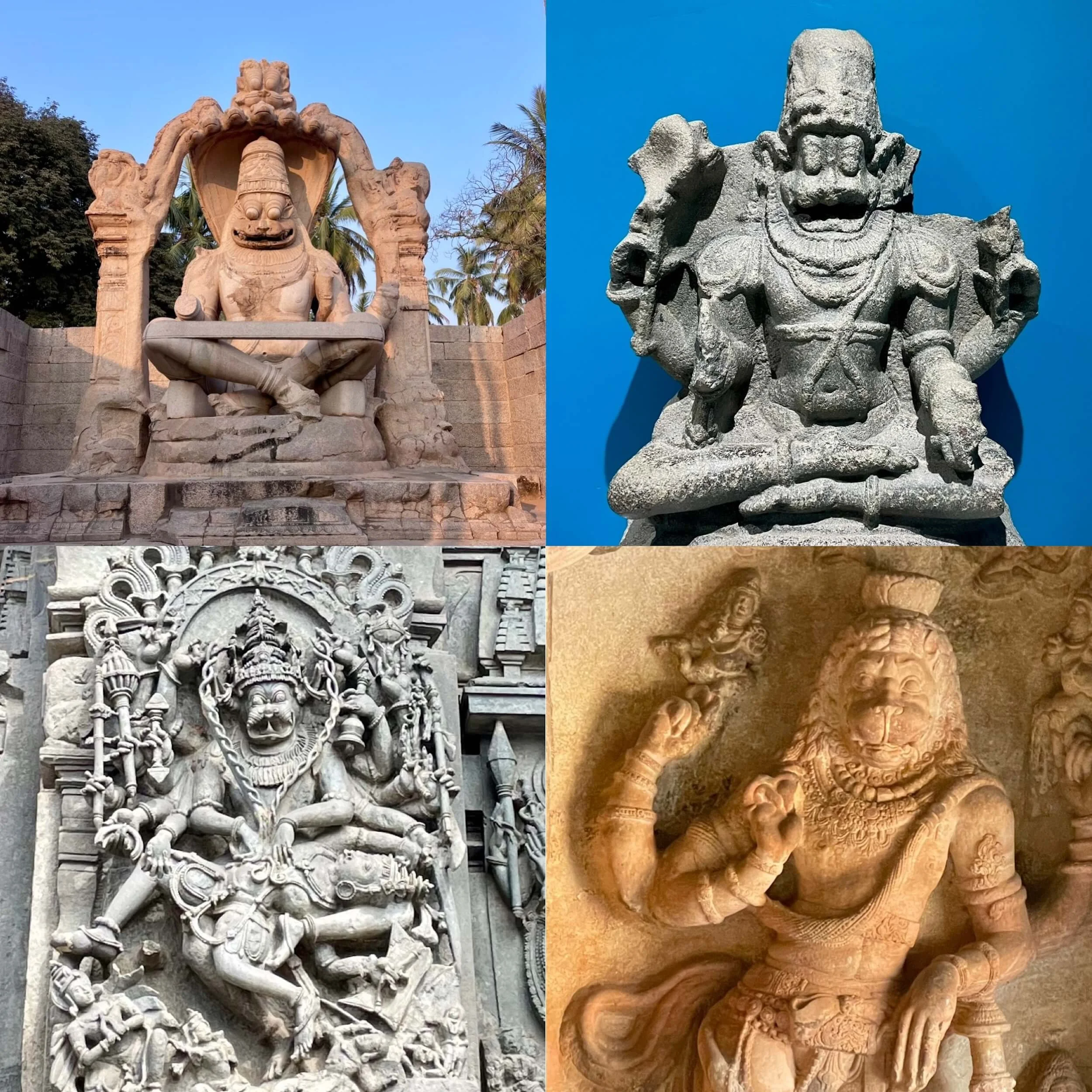
Over 5 years ago, I saved an image on my phone of an ancient sculpture of the deity, Narasimha, sitting in meditation with a yoga-patta (a yoga belt) around his knees. The photo was in BKS Iyengar’s Yoga for Sports. I love art, and there was something about the features of the sculpture, and the link to yoga, that resonated. In January this year, I got to see that sculpture in person. Originally, it was crafted from one stone. And, at 6.7 meters tall, and built around 500 years ago, the spirit of this Narasimha didn’t disappoint (see top left image). It probably helped too, that the statue is situated in Hampi, a unique ‘abandoned kingdom’ known as the Vijayanagara empire, prominent from the period of 1300-1560s common era. It’s an other-worldly experience to be there at times, with a landscape of boulders, tall, thin palm trees, and hundreds of dilapidated temple structures. Still, tucked away somewhat, on the edge of town, experiencing this artwork up close itself was one of my trip’s highlights.
This reflective piece is an attempt to show why I love Indian artworks, in many mediums, and how such a love can aid me just as much in my yoga practice too. The abundance of creativity across India dazzles in its continual and diverse application; its strong sense of form and purpose; a focus on organic processes; and, the exploration of the divine. Here, I’m going to delve into these aspects of this persistent inventiveness in both art and yoga [See Footnote 1].
Travelling in January for two weeks before I began my month studying at Ramamani Iyengar Memorial Yoga Institute (RIMYI), I made sure this time to prioritise the sightseeing of temples and contemporary art galleries in India. With a focus on the state of Karnataka (where BKS Iyengar was born), I traversed historical sites like Hampi, Badami, Pattadakal, Aihole, Bellur, Halebid and Bengaluru/Bangalore. (Prior to going, I was to also discover the Bellur, Kolar district, where Guruji was born, is different to the historical town of Bellur, Hassan district). I was able to tour architecture and see works from the 6th, 12th and 16th Centuries, Indigenous Peoples’ art (here, mostly called Folk Art), and including modern pieces in contemporary museums. I saw pieces in caves, on hill peaks, at the water’s edge, and in art galleries and schools. Structures included highly ornate smaller temples, and large complexes, including palace grounds. I was in my element! The reason for prioritising temples included that, more recently in reading books on Indian Art, I had come to realise that seeing temples in India is to see, and experience, major developments of Indian Art per se. Of course, they are also sacred sites of spiritual development, but here what I’m highlighting even more, is what I’ve come to recognise is the craft of art in this country, and how it has a particularly Indian cultural context. I believe that both art and yoga investigated as ‘crafts’ prove worthy subjects to galvanise our frequent efforts in self-study, especially for those of us who are learning such skills as a long-term commitment.
Why craft?
“Art is an expression of harmony and beauty in one’s way of living. It is a craft wrought between nature, people and environment. It is not a fantasy but a wonder of life. Art is the discovery of the relationship between life and its context,” (Iyengar, ‘Yoga and Dance’ in 2018b, p. 175).
‘Craft’ means a skilled activity, producing something, often by hand. When art is so often defined by that which is made - i.e. looking at the ‘finished product’ - I like instead, the application in terminology of the word craft, as for me, it highlights the process equally too. Why does this matter? When visiting temples in India, one of the things a person is most likely to notice is the absolute proliferation of sculptural pieces within what is known as the ‘temple’ proper. Commonly, as I am learning, there are the architectural elements of, (at least) gates, steps, platforms, pillars, columns, sub-shrines, sub-altars, and then the ‘sanctum sanctorum’ itself (where the murti, the embodied form of the major divinity for that temple, sits). Then, in terms of artworks, particularly in Hindu temples, you’ll find across almost all this architecture, decorative panels, geometrical features, plants, animals, fantastical mythological creatures, humans, gods and goddesses (both major, and minor), and more. Hundreds, if not thousands, of sculptural pieces sitting side-by-side. And all these artworks are carved out of stone. That is, stone that has been around for thousands of years (and, because the wooden and finer materials used in temples historically have, unfortunately, now been destroyed). And from what could be characterised as a rock-hard, inert material, all of the art is made to come alive. Made by the hands of men. Carving all these thousands and thousands of elements took an inordinate amount of time. The kind of time that requires a mental perception different from an immediate result. Indian stone sculptural artwork is therefore, not only thinking about, but literally making, into the longer-term par excellence.
In this country, craft also denotes a membership within a skilled profession. Often these trades were developed within family lines, and the texts talk about ‘houses’ of artisans. Interestingly too, craftsmen would produce works across religions, including for Hindu, Buddhist, Jain and Muslim sacred sites. In the Hassan region, I visited temples that took the families of craftsmen over one hundred years to complete the works. On my last visit to India, I also saw the Kailasa Temple in Ellora that took several generations to finish. It must be quite an experience to be producing something you’ll never see finished in your lifetime. Reading about all of this, and reflecting on the work of these humans by looking at the temples up close, I can better think about perspectives of work, and of effort.
With regard to yoga, thinking of it also as a craft allows me to reflect on the tools, the process of creating, and the development of skills. Yoga, for us, is never complete, done, or finished. For example, at RIMYI in Pune, I observed an intermediate class by teacher Prachi Gondi, where of the 90-minute duration, more than 70 minutes were taken in developing inversion skills. Most of the class was spent with students practicing elements of sirsasana (headstand). Time and time again, students went up, and came down, experimenting with techniques as explained and demonstrated by Prachi herself. Carving out the time, we can see that our sirsasana can improve; we can learn to hold it longer, we can gain more stability, and composure. We can add variations. All of us can assimilate new means. In another class, Prachi said,
‘His [BKS Iyengar’s] asanas are tools for us for life.’
To my mind, this prompt is an encouragement to recognise how such postures, at what at first seem may like the physical level, are actually devices for across our existence. And, if we can grasp this, it’s truly in the realm of artistry.
Fortunately also, one can get better at using tools. In studying in India, as in Australia, I am surrounded by people with more talent, more gifts, for yoga. Supremely vital bodies! Other people can do a far wider set of asana, and there are teaching professionals of 40-50 years, if not basically their lifetimes, dedicated to this method. For some, it’s a family profession, and/or a ‘house’ of apprenticeship. Living yoga. Thankfully however, yoga isn’t particularly interested in creating a ‘monument.’ If the efforts begin to be too externally focused, it’s sure be caught here. Director at RIMYI, Prashant Iyengar (and BKS Iyengar’s son) continually warns against the global obsession with the ‘physical culture’ of yoga. I also find his verbal wariness of dogma refreshingly helpful too. I therefore try to observe, and to listen, to the skillful artisans in my sphere in order to develop my own abilities, for my own context. As Prashant-ji said in class:
‘It’s not just what is being done, you must devise what is happening.’
This happening is part of the craft, a production of consequences for our body, mind, breath and spirit. And even if I only get a glimmer of that pursuit in a class, it’s worth it. There’s an energy there, a ‘pulse’ that sustains me in my day-to-day world. Life, enhanced, via a vibrant inner breath and prana. It turns out that other people have noticed this pulse within Indian sculpture too. And, I’m not alone in feeling the connection of the embodied body across both art and yoga. Austrian-American Stella Kramrisch (1896-1993), the highly esteemed Indian Art historian and curator, writes,
“Indian sculpture relies on life as it is felt within the body and on realisations that transcend life although their locus is in the body… In his creative spontaneity the sculptor forms the body as the vessel of the flux and palpitations of life. His work is in praise of life, in praise of the living body, the seat of life, of consciousness and of the effort of consciousness to master and transcend life,” (1960, p. 36).
BKS Iyengar writes:
“Yoga is a fine art, and like any other fine art it seeks to express the artist’s abilities to the fullest, but with one difference. Most artists need instruments like the violin or a painting brush or ankle bells as aids for their artistic expression. A yogi’s sole instruments are his body and his consciousness,” (2018a, digital copy).
Therefore, in India, you can start with yoga or with art, either way, a deliberation on consciousness comes. A must-read on this topic is Guruji’s own TheArt of Yoga, where in his opening essay, he discusses this idea from his own experience. For example:
“Creativity is a perpetual process which accompanies all normal growth and progress,” (1993, p. 8).
But this is not about textbooks alone. In the main hall, where teachers regularly reference the many images displayed prominently across the walls from BKS Iyengar’s Light on Yoga, I see the applicability of this quote discussing Indian painting:
“[His] gestures are immediate yet timeless. They are those of icons fixed at the highest pitch of concentration,” (Kramrisch, 1986, p. 179).
In addition, Prashant-ji implores us to cultivate this ‘life-force’ beyond any external image. Instead, the craft of pranayama is an ongoing, internal investigation. On Friday nights he steps us briefly through experiments, making us recall that the work that needs developing is ultimately our own responsibility. Thinking, reading, even writing about craft isn’t doing yoga. All the RIMYI teachers induce us to be wary of intellectualising at the cost, or avoidance, of the practice work itself. So it’s an every day ritual for me. I also believe igniting interest can come in different, additional forms. Stories, especially the art of Indian myths, encourage me. Myths are another timeless craft here.
The story of Narasimha
Indian myths, like a majority of the sculptural and traditional art, isn’t really about authorship. And, the myth isn’t one story. It doesn’t stay static. Sure, core elements hold, but there is within this basic structure a great degree of flexibility. Each orator will highlight particular features. One storyteller may tell the same myth differently each time it is told. It is a craft to decide, what is produced in the story at that point. And to what end the myth is being shared.
At an exhibition at the Museum of Art & Photography in Bengaluru/Bangalore, the curators write,
“Myths of beginnings grew from shared imagination, close observation, and a desire to find meaning in a vast, unpredictable universe… Even now, our sense of wonder can remain a powerful guide. It can slow us down and remind us that the world is full of patterns… curiosity doesn’t demand grand questions - only a moment of attention.”
Replace the word ‘myth’ above with ‘yoga,’ and the intent holds.
But first, back to the iconic statue I saw in Hampi. The major pieces of the Narasimha myth is that a ‘demon’ king named Hiranyakasipu (which translates to “Golden Garment,” from Sanskrit) performed the following yogic austerities:
“He stood on his toes with arms outstretched in a type of a vrksasana (tree)pose for so long that ants covered his body in an anthill and consumed everything except his bones and life air,” (Bryant, 2015, digital copy).
By these efforts Hiranyakasipu was entitled to receive a wish-reward from the god Brahma, and he asked to live forever. But finding that he could not directly request immortality, he instead thereby tried technically, to achieve the same aim. ‘Grant me the ability not be killed by human or beast, not to be killed inside or outside, not to die on the ground or in the air, in neither daytime or nighttime, and be sure I cannot be killed with a man-made or mythological weapon.’ This wish was granted, and Hiranyakasipu became even more egotistical and arrogant. He was further antagonised when he found out his son, Prahalad, was a devotee of the god Visnu. To his son he proclaimed, ‘I am as great as any god. Why do you have faith in Visnu? I am more important!’ The king became more enraged because his son wouldn’t falter, and so he said, ‘Where is your Visnu? If he is so great, is he here?’ His son’s belief was affirmed in his verbal reply. The father retorted, ‘So let him appear! Or you will be killed for your ignorance!’ And with that, Visnu, in the form (avatar) of Narasimha blasted out of the pillar at the edge of the palace, being neither inside or outside. As Narasimha, he was embodied as half-man, half-lion. And, at the time of twilight (neither day, nor night), he took Hiranyakasipu over his thigh (neither in the air, or on the ground), and killed him with his claws. That’ll teach you.
(There’s even more to this myth including the god, Siva, becoming his own version of a lion-creature to then defeat Narasimha. Plus, there’s also a key role of the Goddess Lakshmi too, and the importance of ‘feminine energy,’ but I fear if I tell every thread, the narrative won’t end.)
Herein, we find core elements of the story to educate us on characteristics like egotism, arrogance, ignorance, doubt, faith, courage, and in-betweenness. Mythologist Devdutt Pattanaik particularly highlights this ‘in-betweenness’ in the story of Narasimha, and anyone who has ever felt out of place, can relate. Not concretely one thing or another. Or, changing. Travelling, and being at RIMYI, I certainly experience in-betweenness a lot. Much of being here does not come easily for me. The myth itself can act as a prop-mirror for me to ask myself when I am showing aspects of any of the three characters. When is my ego imagining I should receive some kind of result? When do I need to have faith and just get on with it? Can I handle being in-between? For how long? What would having faith mean?
The opening image-collage includes just four of the several versions of stone Narasimha’s I saw in Karnataka. If you look at some of that imagery, he can look vicious, but, there are also forms of him in contentment. I think the Narasimha I saw at Badami caves is almost Disney-esque, with his posture and fine features (see bottom right image). Jaunty! Just like the myth, there isn’t one kind of Narasimha statue either. There isn’t one artwork, there isn’t one story. The philosophy of yoga also rightly warns us attaching set narratives unnecessarily to any one experience. Paraphrasing teacher Raya Uma Datta, from a workshop session, he said, ‘Once you’ve done the asana over a thousand times, in all the variations, then perhaps we can talk about your feelings towards it…’ For better, or for worse (and it can be both), things don’t stay stable.
So what’s the thread I’m highlighting here? It’s this: in repetition a craft can emerge. And, we don’t have to rely on the ‘luck’ of in-born talent. We can move beyond predisposition alone. Teacher Kishore said in a class, ‘You have to observe where there is darkness in the body.’ Go there, and observe, then get to work. He was arguing for bringing light to our ignorance, including at the cellular level. At RIMYI, we are all encouraged to study our own mind, breath and body, again and again in practice, and using the tools we have, to try and bring luminosity. Across art and yoga, the repetition is a crucial component. As the Indian art writer and retired academic, Vidya Dehejia argues, “Variety in repetitivenessseems to be the theme of these friezes,” (my emphasis) (2018, digital copy).
I try to think about this, as I apply it to both yoga and life. How do my cumulative actions ‘build’? Finishing one intensive class at 7.30pm, and turning up the next morning at 5:45am, I have to work out how to sustain all of myself. The experience is a very live enquiry, especially in the dust and heat of Pune (yes, it’s winter, but it’s still hot and there’s sometimes over 100 of us crowded in). And because after that 90 minutes, it’s 3-hours of self-practice. And then there’s tomorrow’s schedule, and the day after. Take a break? Keep going? It’s all a choice, each and every day, 6 days a week. Observing myself, how my body and my mind respond, the element I try to hold onto the most is the quality of my breath. If I begin to notice my eyes bulging, throat tightening, getting dizzy… these are signs I’m pushing too hard. I tell myself, ‘Don’t pop your eyes out like the Narasimha statue, Jackie! Don’t turn your own body to stone!’ Instead, breathe. Mostly, exhale. An absolute benefit of being here is the sustained time I need to repeat efforts to learn how to keep the outer body holding the structure of my human frame well, so I can nourish the inner, organic spaces. Senior Teacher, Sunita Iyengar (and BKS Iyengar’s daughter) asks us to remember the integral relationships between the karmendriyas (organs of action), jnanedriyas (sense organs), and practice. If everything is put under extreme pressure, disassociation occurs. ‘Proud and cranky,’ teacher Dr Naik warns (just like Hiranyakasipu. And, no one wants them in a yoga room).
Work-ship, worship
Attending what I call ‘working temples’ in my travels (as opposed to historical buildings where priests are less common), I also saw up close the diverse religious faith of people in these holy sites. I also thought quite a bit about the term ‘faith’ itself. In Sanskrit, a word used is sraddha. Sraddha, though, is more terminologically-flexible than faith in English. For example, BKS Iyengar writes,
“Sraddha is not mere faith, but a ripened revelation through experience,” (2018a, p. 127).
Ripening happens over time. It’s a process. Later, Guruji writes,
“Patanjali [the author of the Yoga Sutras] advocates continuous, steadfast effort so that the subject reveals information to build up faith on its own,” (2018c, p. 70).
Imagine when the sculptor stood back and saw that from one block, an image of a god was created by his own hand. And although it was stone, because of his skill, it had the essence of breath within. This is how I try to think about practice. To chisel away, to see what this body and mind can evolve into, at this time, and over the years. And what does this work do for the spirit?
Developing sraddha in yoga is therefore important for me because this is a major component of my life. Any genuine commitment requires a kind of faith to ride the ups and downs. It doesn’t just need to come from yourself, although I do think that’s a big part. When there’s camaraderie to assist each other out, or learn something from someone with more experience, that’s enlivening too. It includes being inspired and/or energised by others, whilst at the same time being wary of too many comparisons. I try to think about inspiration versus ‘plagiarism,’ or imitation. Teachers at RIMYI spend quite a lot of time actively warning about emulation. I can be inspired by other people’s skills and craft, but in the end, it’s just me and my own tools. Plus, I don’t think mirroring the faith of others helps you in the longer-term. It’s a personal concept and application. In yoga, your accountability is to yourself. As Sunita-ji says to the class one Saturday,
‘Your soul is really the only one truly observing you.’
There’s a challenge and a freedom in that. I tried to observe as many classes as I could because that way I get to see the style and personality of different teachers. I think as learners, this is very important. I don’t believe mimicry is any Iyengar teacher’s wish for those they mentor. Most guard against it quick smart. As I’ve said, copying isn’t crafting. Spending time here, I think my job is to try and learn the ‘threads’ within the methodology, and work out what that means for me. Plus, in the privilege of teaching, then I must work even harder to externalise some of that developed practice in an effort to ignite self-reflection and development within other people in classes, too. You can tell me how that goes.
There’s also a relationship for me in learning about sequencing asana and repetition. I can absolutely feel the magic in the art of sequencing. Like any subtle craft, it’s not often until much later, that I can even begin to uncover some of the ripples of that knowledge. On a physical level, the benefits of sequencing come in different modes. The better quality of breath at the closing of a class is one such sign. Sustained energy is another clue. This month of study permits a committed period to open out these ideas. To engender comfort with, or in, changing ways of being. Conceivably then, faith also includes practicing a belief in process for itself, without a fixed sense of outcome. I’ve spoken about seeing ancient stone artworks, but I do not forget the wonderful traditions of coloured sand mandalas, or the flower garlands and other perishable decorations used here on a daily basis. Some Indian art is designed to perish, or dissolve quickly. It’s more about the mindset and application. It’s made to be released. This means making a lasting ‘product’ does not necessarily make it more legitimate or worthwhile. To craft something as a way of letting go has an altogether different potency, and one I remain curious to cultivate.
Storytelling
Intensives are intense. In Pune, I live around the RIMYI schedule, which means long days and extended periods of concentration, Monday to Saturday, for four weeks. I make notes after classes. I’m observing over 16 dedicated, thorough, teachers. I’m also imbibing the passion of the assistants, local and visiting students, the precision and energies of senior visiting teachers. I’m attempting to make my own head-way in what is a practice-based technology. This includes my own self-analysis in what is ostensively, a group environment, and a highly cross-cultural one at that. Dr Naik talks in a class about how we need sticky mats because of our slippery legs. My brain often feels slippery here too. And, as I’ve been using the analogy of art, I feel I am honestly very far from any major ‘works.’ Even the drafts feel pretty pitiful! When I write this reflection, I guess there’s also a chance I’m still attempting to write a manufactured, or overly-contained narrative, with a neat beginning, middle and end to what happened. We need to be aware that the myths of RIMYI are as real as anywhere else. Any linear story of my experience is harder to summarise. Or if I do, it may just be artifice. Some days were psychologically hard for me. Being amongst lots of new people, and being surrounded by a wide variety of experiences, means at times I felt like a small boat in a large sea. My friend highlighted how travelling itself is a live ‘laboratory in dependencies,’ and how most of them are outside your control. Some small things can bounce me around much more than I’d care to admit. I have to keep checking-in with myself: what am I here for? What’s important for me right now? How to be yourself, and, how to go beyond conceptions of yourself. For other people, some of this probably comes far easier. Or they have other concerns. That is, in part, why I do all of this: yoga is an embodied system to act, reflect, act again, reflect again. Plus it reinforces the recognition that we really have little idea what is happening for others. Therefore, facing up to how I exist amongst all of this, including other people’s contexts, is a part of my ongoing work. Being in-between. And, like any story, I have only partial information, a particular lens, to see others, and to try and see myself. Sunita-ji nudges us,
‘It easy to look at others. It is much harder to study yourself. You have to do, you must search it out.’
I’m not also talking about a self-concentration, or self-absorption, in an egoistical way (likely, easier to write than to be sure, I think). Dr Naik calls it ‘internal observership.’ In the last class with Head of RIMYI, Abhijata Iyengar (and Guruji’s grand-daughter), she usefully reiterates a key component in Sutra II.1, woven together like a braid:
tapah svadhyaya Isvarapranidhanani kriyayogah
Svadhyaya, self-study.
Even as I write this, I haven’t quite landed on a word, or set of words, for how I felt for a large part of time here. Disoriented comes somewhat close, but it’s not quite right for the times I felt highly oriented to my purpose. Liminal? Marginal? (How to explain being passionate about something as much as owning that it deeply challenges you; and which can feel counterintuitive to be pursuing ardently when the discomfort can be high.) Whatever the case, I moved between the hours of activity at the Institute, and also, in spending relatively long periods of time by myself in the quietness of solo travel (which is even more in contrast to the highly communal ways of living in India). Obviously, therefore, I was in different habits and contexts from ‘everyday life,’ and possibly I tuned into aspects of myself that are more often obscured by the noise of the day-to-day. Maybe, as the third time in about three and a half years of study at RIMYI, the repetition itself is beginning to reveal, or unravel, experience in a different manner, and one I can’t quite get light into… Observing a class as the month was coming to a close, teacher Pavritha alerts her students to pay attention post-asana, and, post-class to the effects, not just during a pose. Teachers’ SeemaJoglekar and Raya each discussed aspects of gravity over the month, as both the science, and as a mental concept. Perhaps the importance I put on my time here, is another kind of gravity I’m assessing. With value comes hope, with hope comes vulnerability. Not all is for explaining either. Sometimes come the classes that are experienced on a level beyond adequate words for description. They shake me up, and definitely take me out of my head. Abhijata taught a number of such sessions. It’s like plunging into water, sometimes it’s moving this way, sometimes in another direction. These currents can feel in the moment overwhelming. The flow in purpose however, is absolutely present, and it’s strong in its own unique, visceral way. Elemental. I’m pretty sure that people used to being, and teaching, at RIMYI see it on our faces at the close of class. I think you can hear it in the bubbling of talk and smiles as students leave. (Including that I’m positive I/some of us, hopefully go from wild-eyed to an energised calmness at the end!)
Even more so than articulating the feelings, I came to realise that whatever my moods, time was passing. Early morning, the birds calling out in waves of trills are a reminder that it is all movement. Another day. Indian artistry grapples with time head-on:
“The concept of Time as a creative principle is as old as the Vedas [the first sacred ancient texts of India],” (Rajan in Kalidasa, 2006, Introduction, digital copy).
Within this context, ‘being’ carries its own experience. A month at RIMYI - any trip away - it will start, and end. This is why I attempt to jot these words: I’m hoping these experiences produce a kind of embodied cognition in me, even if it’s not neat. And therefore, I return to the self as a tool, the products we’re making even when we don’t quite realise it, and the role of the craftsperson. In Light on Yoga, BKS Iyengar writes,
“The practice of an art is more difficult to communicate than a purely literary or philosophical concept,” (2022, Preface).
Right here, right now - at every moment, in this body - I have tools to learn. And hopefully, at RIMYI, I’m cultivating new strategies, and refining skills, in this approach. Prashant-ji literally said it one Friday night:
‘Come here to learn what to learn.’
As the month came to a close, we were lucky to observe an in-person workshop for Indian students who attend RIMYI classes online, but who live in cities far away from the Institute itself. Witnessing both the friendliness (Sanskrit: maitri) and the devotion to education from the teachers here is very special. This continual care is something to behold. For me personally too, recognising and paying respect to Yoga as an Indian Craft, is vital. This is why I will try to keep coming back to this country, and learning from/with its people, in reading the authors, in engaging with its arts.
I opened myself up, and have attempted to absorb what I can with a faith in the power of ‘life force’ artistry. How that percolates and permeates into new skills, this, I will have to wait to see. I cannot be granted a wish to suddenly perform new feats. So whenever I flag, engaging with art helps. As the great Indian poet and polymath, Rabindranath Tagore (1861-1941) writes:
“Thy infinite gifts come to me only on these very small hands of mine. Ages pass, and still thou pourest, and still there is room to fill,” (2025, first published 1910, Poem 1).
By practice, may the creativity, the light, persist and even, grow.
NOTE
For all the quotes referencing the professional staff at RIMYI I have used these ‘…’ punctuation marks (rather than “…”), because I was not taking direct quotes in class, nor is this designed to be a journalistic piece per se. Obviously, I have aimed to be as faithful to their words, and the context in which it was used, as possible.
FOOTNOTE
[1] As this was my third trip to Pune and RIMYI, I’m attempting in this writing to move beyond the didactic, into more of the exploratory. For more on the ‘what, where and how’ of previous trips, see here (2023) and here (2024).
IMAGE REFERENCE (Clockwise)
Top Left: Lakshmi Narasimha Temple, Hampi, consecrated 1528 (16th Century) common era.
Top Right: Narasimha in Siddhasana, Hampi Archaeological Museum
Bottom Right: Narasimha, Badami Caves, Cave 3, 578 (6th Century) common era.
Bottom Left: Narasimha, Hoysaleswara Temple, Halebidu, 12th Century common era.

Jackie Ruddock
Jackie Ruddock has been practising Iyengar yoga since 2008, and joined Central Yoga School in 2018. She is a certified Level 1 teacher.
References
Bryant, Edwin, The Yoga Sutras of Patanjali: a new edition, North Point Press, 2015 (digital copy).
Dehejia, Vidya, Looking Again at Indian Art, Publications Division, 2018.
Iyengar, BKS, The Art of Yoga, Harper Collins, 1993.
Iyengar, BKS, Astadala Yogamala: Volume 1, Avant Publishing, 2018a.
Iyengar, BKS, Astadala Yogamala: Volume 3, Avant Publishing, 2018b.
Iyengar, BKS, Astadala Yogamala: Volume 7, Avant Publishing, 2018c.
Iyengar, BKS, Light on Yoga, Thorsons, 2022 (digital copy).
Iyengar, BKS, Light on Yoga Sutras of Patanjali, Thorsons, 2012 (digital copy).
Iyengar, BKS, Yoga for Sports, Westland, 2015.
Kalidasa, The Loom of Time: a selection of his plays and poems, Penguin Classics, 2006. Translation by Chandra Rajan.
Kramrisch, Stella, Indian Sculpture: in the Philadelphia Museum of Art, University of Pennsylvania Press, 1960.
Kramrisch, Stella, Painted Delight: Indian Paintings from Philadelphia Collections, Philadelphia Museum of Art, 1986.
Museum of Art & Photography (MAP), Beneath the Turning Sky Exhibition, Bengaluru/Bangalore.
Pattanaik, Devdutt, 7 Secrets from Hindu Calendar Art, Westland, 2022 (digital copy).
Pattanaik, Devdutt, Myth = Mithya: Decoding Hindu Mythology, Penguin, 2014.
Pattanaik, Devdutt and Rulli, Matthew, Yoga Mythology: 64 Asanas and their stories, Harper Collins (digital copy).
Tagore, Rabindranath, Gitanjali, Penguin Select Classics, 2025 (first published 1910).