
Why Practise Yoga When The World Seems So Uncertain?
There is no shortage of reasons to feel unsettled at present. News of conflict, political division, environmental concerns and the rapid development of artificial intelligence reaches us almost continuously. Rarely has so much information been so immediately available, and rarely have there been so many competing demands for our attention.
It is understandable that many people feel distracted by these developments. Yet they also raise an important question from the perspective of yoga. As our attention is increasingly drawn towards what is happening in the world, are we paying sufficient attention to what is happening within ourselves?
During one of my later visits to the Ramamani Iyengar Memorial Yoga Institute in Pune, this question presented itself in a way that I did not fully appreciate at the time.
A Lesson From Geetaji
Geetaji Iyengar had already been unwell for some time and was no longer teaching her regular classes. Everyone at the Institute knew her health was fragile. On one of the Indian festival days she came out to address the students. She appeared physically frail, and I remember wondering what she would choose to speak about. It seemed an occasion that invited reflection on life, on practice, or perhaps simply a few words of encouragement.
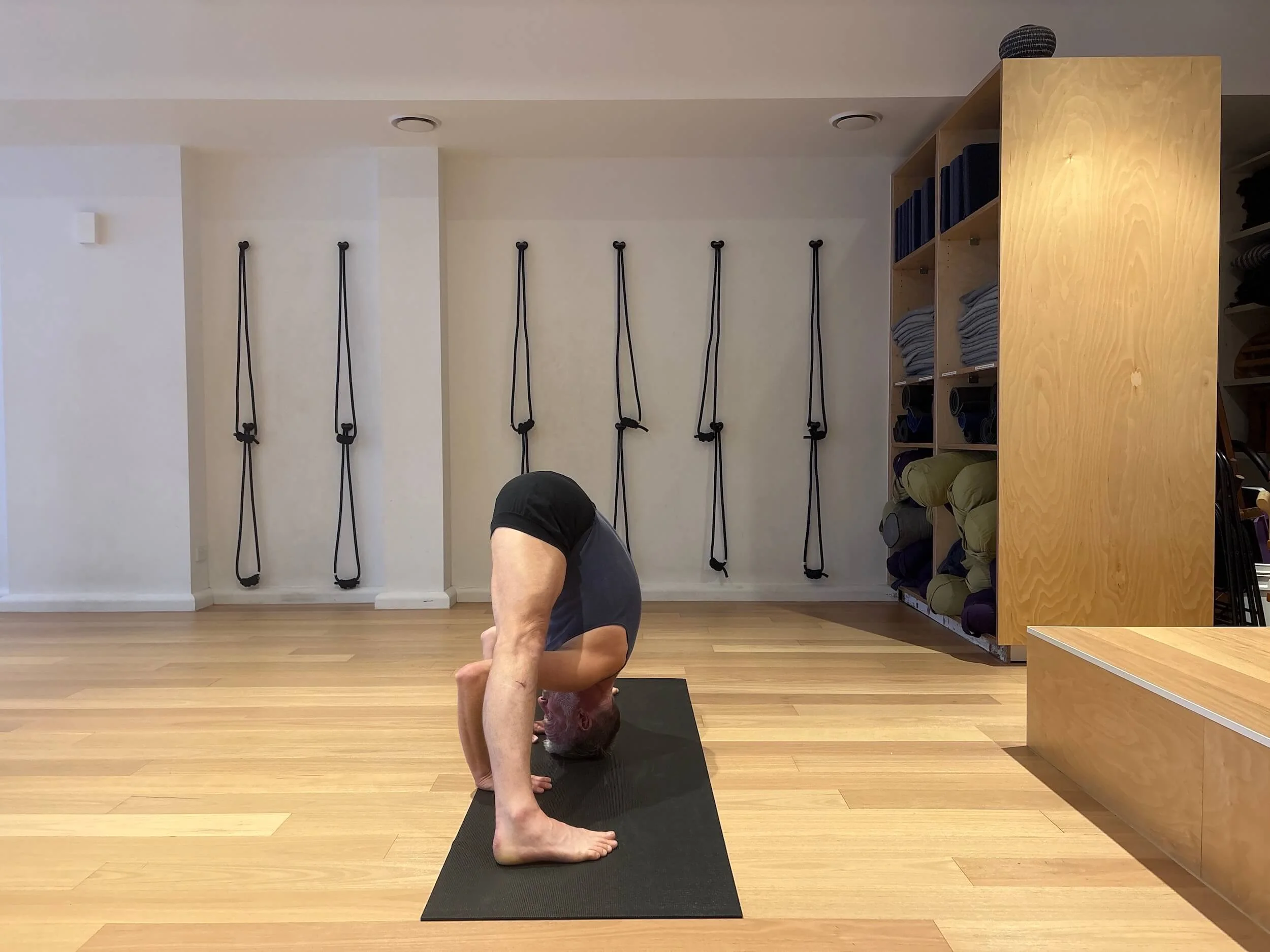
Instead, she spoke passionately about the work of the legs in Prasarita Padottanasana.
Even in her weakened condition she became animated explaining the actions required in what many would regard as one of the most fundamental standing poses. At the time I found it difficult to understand why this particular topic should command such intensity. Given her circumstances, it seemed an unexpectedly ordinary subject on which to become so engaged.
Looking back, I think the answer reveals something fundamental about the practice of yoga.
Where Does Yoga Direct Our Attention?
It is easy to assume that yoga becomes less relevant when life is uncertain. We naturally feel drawn towards events unfolding around us, particularly when they seem significant or beyond our control. Yet yoga asks a different question. Rather than focusing exclusively on what is happening in the world, it asks us to consider what is happening to the consciousness that is experiencing the world.
Patañjali defines yoga as citta-vṛtti-nirodhaḥ - the cessation of the fluctuations of consciousness. While this aphorism is familiar to many practitioners, its implications deserve careful consideration. Yoga is not primarily concerned with changing external circumstances. Instead, it concerns itself with refining the instrument through which those circumstances are perceived.
This distinction is important.
There have always been reasons for anxiety. Every generation has faced uncertainty in one form or another. Today it may be climate change, artificial intelligence, political instability or economic uncertainty. Tomorrow it will be something else. Yoga does not promise to remove these difficulties, nor does it suggest that we ignore them. Rather, it seeks to cultivate discrimination, steadiness and clarity so that we are able to engage with life more intelligently.
The Example Of Guruji
Thinking about Geetaji also reminded me of another experience from a few years earlier.
During one of my visits to Pune, Guruji's health had also begun to decline. Naturally there was concern amongst students at the Institute, and conversations often turned towards his condition. Yet the atmosphere within the Institute remained remarkably consistent. Classes continued. Students practised. There was never any suggestion that the uncertainty surrounding Guruji's health should become a reason to neglect practice. If anything, the opposite seemed to be true. The message was clear: attend to your practice.
These two experiences have remained with me because, although they occurred several years apart, they expressed the same principle. Neither Guruji nor Geetaji suggested that practice should be postponed until circumstances became more favourable. Both, in different ways, demonstrated that the discipline of yoga remains relevant precisely when life becomes uncertain.
Why The Details Matter
This is one of the reasons why āsana occupies such an important place in the Iyengar method.
To someone unfamiliar with yoga, the detailed instructions given in class can appear overly meticulous. Why spend so much time on the placement of the feet? Why be concerned with the direction of the kneecaps, the action of the thighs or the extension of the side chest?
The answer is that these are not merely physical details.
As Guruji wrote in Light on Yoga, ‘The yogi conquers the body by the practice of asanas and makes it a fit vehicle for the spirit.’ This statement is easily misunderstood if read as suggesting that the body is merely something to be mastered. Rather, it points to the purpose of āsana practice. The body is cultivated, refined and educated so that it no longer becomes an obstacle to deeper perception. It becomes an instrument through which the mind and consciousness may also be refined.
Refining Consciousness
As Guruji repeatedly demonstrated, the body provides a means through which consciousness can be educated. Attention becomes progressively more refined as we learn to observe more accurately, respond more intelligently and remain present within the pose. The actions of the body are not separate from the actions of the mind. They influence one another continuously.
This also helps explain why Iyengar Yoga gives such careful attention to seemingly small actions. The placement of the feet, the firmness of the legs or the extension of the spine are not isolated technical details. They are opportunities to cultivate attention. Every correction asks the practitioner to observe more accurately, discriminate more clearly and respond more intelligently. What appears outwardly to be a physical refinement is simultaneously an education of consciousness.
Seen in this light, Geetaji's insistence on the work of the legs in Prasarita Padottanasana begins to make much more sense.
Practice As Participation
She was not simply discussing the mechanics of a standing pose. She was directing our attention towards the very process through which yoga is practised. The refinement of consciousness occurs through the refinement of action. It is cultivated one observation at a time, one correction at a time, one breath at a time.
This is also why regular practice cannot easily be replaced by simply reading about yoga or thinking about yoga. Yoga requires participation. Every time we step onto the mat we are given an opportunity to observe habits that ordinarily remain hidden: impatience, distraction, ambition, dullness, restlessness or carelessness. The pose becomes a mirror through which these tendencies may be recognised and gradually transformed.
Patañjali defines abhyāsa, or practice, as ‘the effort to maintain steadiness’ (Yoga Sutra I.13), adding that practice becomes firmly established only when pursued ‘for a long time, without interruption and with devotion’ (I.14). There is no suggestion that practice is appropriate only when life is proceeding smoothly. On the contrary, continuity is part of the very definition of practice.
Discipline Of Attention
This understanding seems particularly relevant today.
Modern life continually competes for our attention. Information is available at every moment. Devices ensure that we are rarely free from interruption. It becomes increasingly difficult to sustain attention on any one thing for very long. Yet yoga asks us to do precisely that. It asks us to remain attentive to the placement of the feet, the extension of the spine, the quality of the breath and the quiet observation of the mind itself.
This is not an escape from the world. It is a discipline of attention.
The more carefully attention is cultivated, the more capable we become of responding to life with clarity rather than habit. We may still feel concern about the challenges facing society, but concern need not become agitation, and awareness need not become anxiety. Yoga offers a means of engaging with the world without becoming overwhelmed by it.
The Practice Continues
Looking back, I no longer think Geetaji's talk was really about Prasarita Padottanasana. Rather, it demonstrated where a lifetime of yoga had directed her attention. Even as her own body weakened, she continued to emphasise the work through which consciousness is refined.
The world will always present reasons to become distracted, anxious or uncertain. Yoga does not ask us to ignore these realities. It asks us to cultivate the steadiness and discrimination through which they may be met more intelligently. Seen in this light, the insistence of both Guruji and Geetaji that practice should continue no longer seems surprising. It simply reflects one of the fundamental principles of yoga: that the quality of our participation in the world depends upon the quality of the consciousness we bring to it.
Interested in making a yoga practice part of your daily routine? Check out our in-person / online weekly timetable here.
James Hasemer
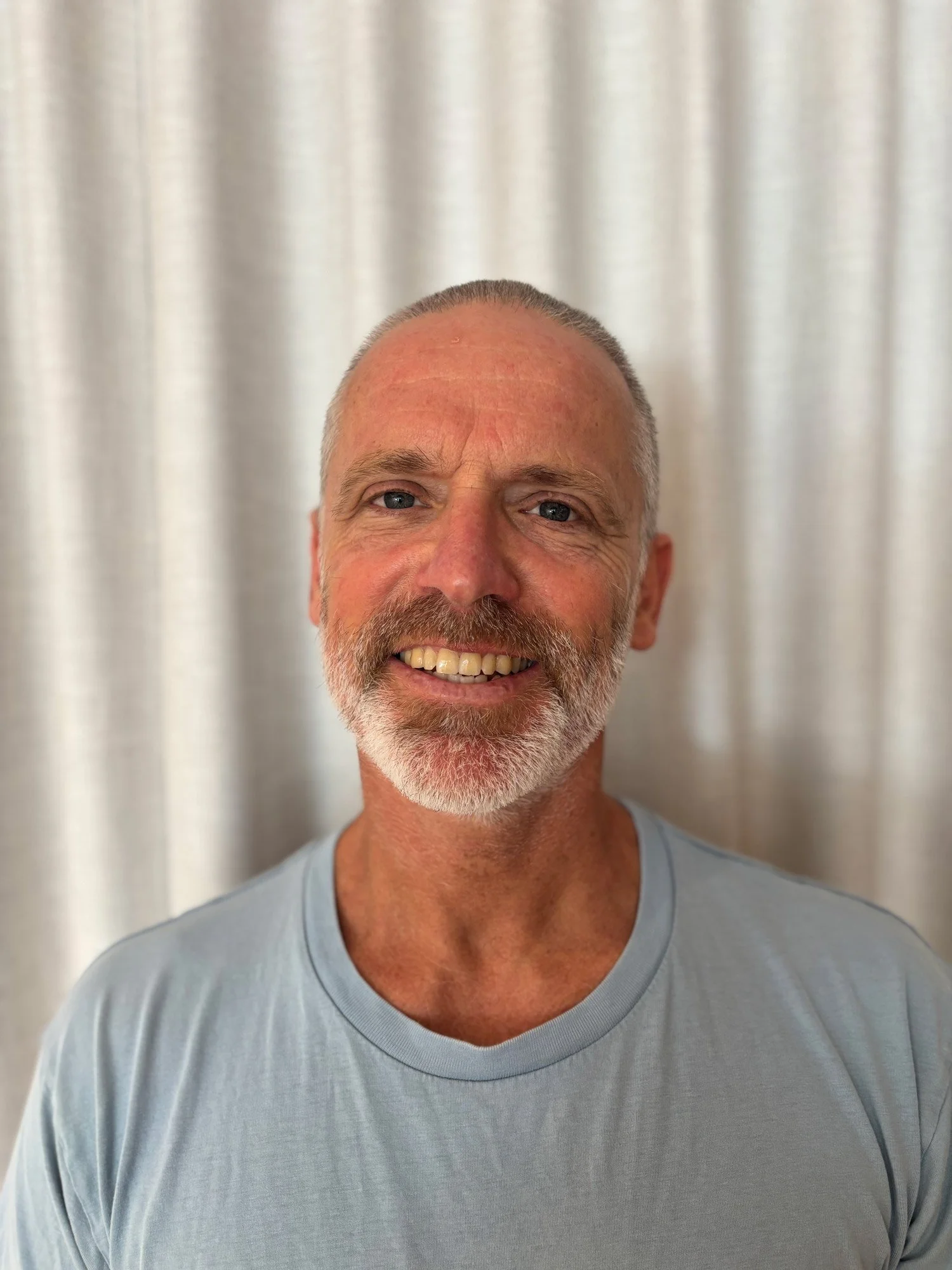
James Hasemer is the Founder and Director of Central Yoga School and a Senior Iyengar Yoga Teacher, Assessor, and Moderator. He has also served on the Iyengar Yoga Australia Board as Teacher Director and Teacher’s Committee Chair from 2021 - 2025.
References
[1] Iyengar, B.K.S. (1993) Light on the Yoga Sutras of Patañjali. HarperCollins.
[2] Iyengar, B.K.S. (2002) Light on Life. Rodale.
[3] Iyengar, B.K.S. (2012) Core of the Yoga Sutras. HarperCollins.
[4] Patañjali Yoga Sutras, particularly I.2 (yogaś citta-vṛtti-nirodhaḥ), I.13–14 (abhyāsa), I.15–16 (vairāgya)